Drop PDF claims here for instant processing
CLM-2847
Auto accident • $12,450 • Policy match: 98%
Approved
CLM-2848
Property damage • $8,200 • Needs review
Review
CLM-2849
Medical • $3,850 • Policy match: 95%
Approved


Join 60+ AI Engineers
We'll build your personalized roadmap, help you build a production-grade portfolio, and apply for jobs on your behalf until you have a signed offer in hand.
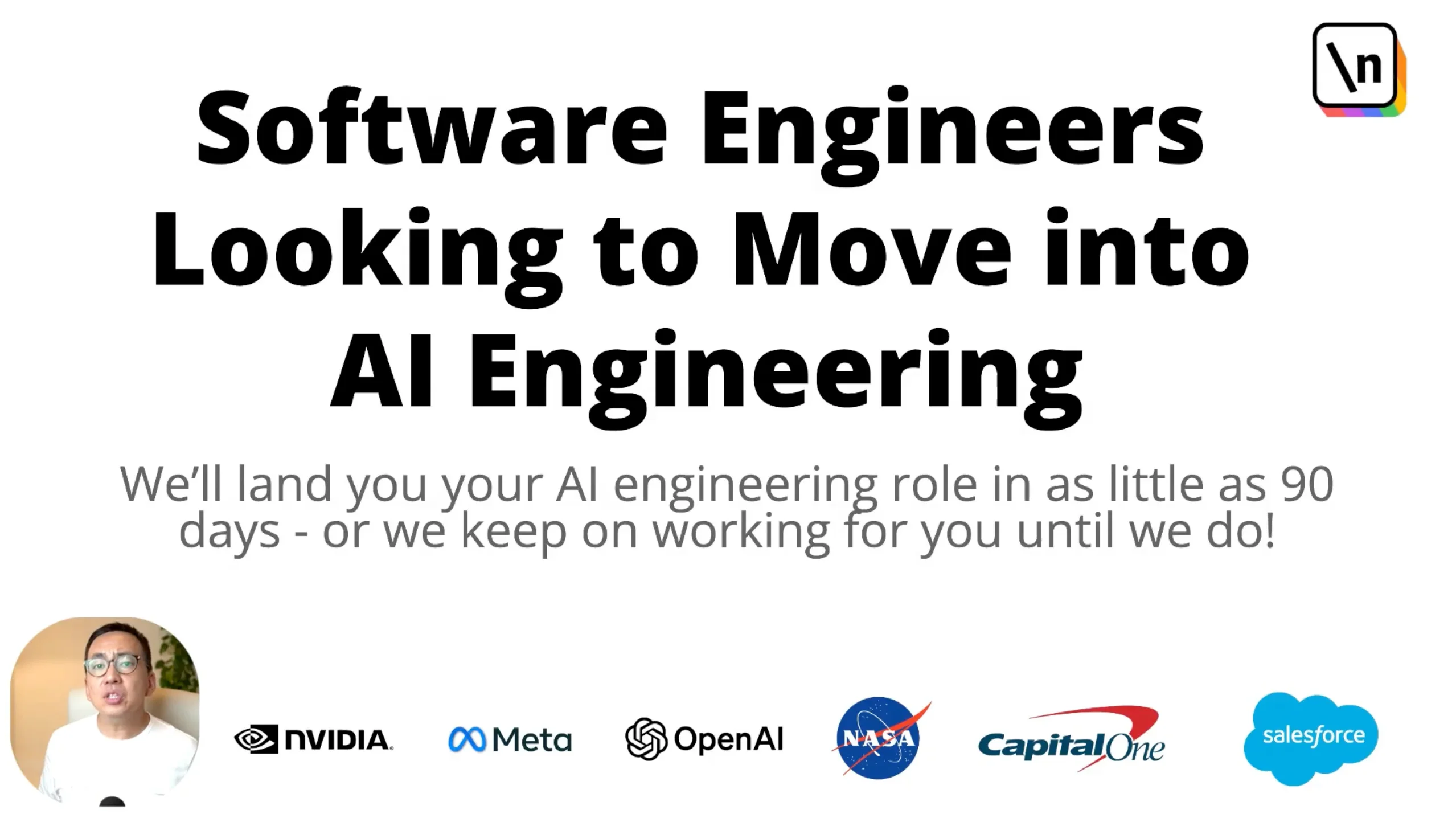
TAKE THE NEXT STEP
Instead of spending months figuring out what to learn, you'll walk away with a clear path built around your specific stack, experience, and the roles you're targeting. Every skill you build moves you closer to an offer.
We'll show you what separates engineers who land AI offers from those who don't, based on what we're seeing from companies actively hiring right now. Not theory. Not what universities think matters. What actually gets you hired.
We'll show you how to leverage the experience you already have to move into an AI role faster than starting from scratch. Your background isn't a limitation but the foundation we'll build on. See what's possible: the apps below were built by engineers who came in with the same background as you.
[00:00] I'm a very experienced software engineer. I have been in the industry for over 25 years.
[00:04] I started my work mostly on the low level stuff as an embedded systems engineer, operating systems, device drivers, et cetera.
[06:09] And later moved up the stack to distributed systems and I really enjoyed working on full stack applications...


| ID | Customer | Revenue | Date | Status | |
|---|---|---|---|---|---|
| 001 | John Smith | [email protected] | $45,200 | 2024-01-15 | ✓ Valid |
| 002 | Jane Doe | invalid-email | $32,800 | 2024-01-16 | ⚠ Error |
| 003 | Bob Johnson | [email protected] | $58,900 | 2024-01-17 | ✓ Fixed |
| 004 | Alice Williams | [email protected] | $41,500 | 2024-01-18 | ✓ Valid |
| 005 | NULL | [email protected] | $29,300 | 2024-01-19 | ⚠ Error |
ABOUT US

Zao Yang isn't just another AI instructor — he's an entrepreneur who's been building and scaling products for over a decade. As the co-creator of Farmville and founder of Newline, an online education company for developers, he's helped over 250,000 engineers level up their careers.
Today, Zao is at the forefront of AI — building real applications and teaching senior engineers how to translate their skills into the AI economy.
Co-creator of FarmVille: reached over 200 million users and generated $3 billion in revenue
Founder of Newline: an education company trusted by 250,000+ software engineers worldwide.
AI builder & Investor: actively building AI applications and has invested in over 130+ startups.

Dr. Dipen Bhuva is an AI/ML researcher with 150+ citations and 16 published research papers. He has three tier-1 publications, including Internet of Things (Elsevier), Biomedical Signal Processing and Control (Elsevier), and IEEE Access. In his research journey, he has collaborated with NASA Glenn Research Center, Cleveland Clinic, and the U.S. Department of Energy for various research projects. He is also an official reviewer and has reviewed over 100 research papers for Elsevier, IEEE Transactions, ICRA, MDPI, and other top journals and conferences. He holds a PhD from Cleveland State University with a focus on large language models (LLMs) in cybersecurity, and also earned a master's degree in informatics from Northeastern University.
PhD in AI/ML: Cleveland State University with focus on large language models (LLMs) in cybersecurity
150+ Citations: 16 published research papers with three tier-1 publications (Elsevier, IEEE Access)
Research Collaborations: worked with NASA Glenn Research Center, Cleveland Clinic, and U.S. Department of Energy
MASTER AI


Get started with AI development essentials. Set up your Python environment, learn Jupyter Notebooks, and explore the AI ecosystem including Hugging Face, hardware options (GPUs, TPUs), and productivity tools.
Explore the landscape of LLM projects and understand the building blocks. Learn about different AI application types including RAG, vertical models, agents, and multimodal apps.
Master prompt engineering from structure to evaluation. Learn about tokens, embeddings, and how AI understands text, images, and audio across different modalities.
Deep dive into multimodal embeddings with CLIP and build retrieval-augmented systems. Learn contrastive learning and implement advanced RAG techniques.
Build n-gram language models from scratch and understand classical approaches. Learn 2-tuple loss embedding fine-tuning for search and ranking applications.
Understand self-attention mechanisms and build transformer layers from scratch. Master instructional fine-tuning with LoRA for domain-specific tasks.
Explore feedforward networks, loss-centric training, and multimodal fine-tuning. Learn how to adapt CLIP for specialized classification and regression tasks.
Build a complete transformer architecture from scratch. Master advanced RAG techniques and learn from production-grade systems.
Apply fine-tuning to real-world scenarios: insurance claim processing and math reasoning. Learn tool-augmented fine-tuning with symbolic reasoning.
Master preference-based fine-tuning with DPO, PPO, RLHF, and GRPO. Reverse engineer AI code agents like Copilot and Cursor.
Master agent design patterns including tool use, planning, reflection, and collaboration. Build text-to-SQL and text-to-music architectures.
Study advanced transformer optimizations from DeepSeek-V3. Learn the complete LLM production chain from inference to deployment.
Master RAG hallucination control for enterprise search. Prepare for AI engineering roles with interview prep and career strategies.
Learn how to stay current with AI research, news, and tools. Track foundational trends and understand the evolution of AI technologies.
SUCCESS STORIES
One of the things that I've noticed from going to countless university courses is that you end up falling behind because the content is not recent and you also lack mentorship. With this bootcamp, I was able to talk to people in the industry who are actively working in data science or ML and they helped me think about problem-solving differently whether it was with ML or generative AI. I have been able to use the skills I learned in this course to work on and solve generative AI problems at my current job, which couldn't be possible without this course.

Senior Software Engineer · Capital One
The bootcamp is very deep and I got a lot out of the lectures, coaching sessions, and the case studies. I also got a lot out of working with other participants in the boot camp and bouncing ideas off each other. It's not just presentations but it was actually code and exercises and homework with pretty deep exercises. So I think one of the things that you get out of the boot camp is not only theory, but you also have to build and ship products. And that's what this boot camp prepares you for.

Senior Software Engineer
I recently completed the Full-Stack AI Bootcamp, and I can confidently say it exceeded all my expectations. If you're serious about learning AI engineering in depth, then this is the bootcamp to join, from start to finish.

Senior Software Engineer · BlueTread
What I liked the most about the course is the project coaching. I like the fact that you get help with projects. I like the encouragement of being in a community of people that are all doing the same thing and kind of working towards a common goal. I thought the content would be totally overwhelming, but it really wasn't that bad. It was something that I could do and was really cool.

Software Engineer
I was looking for a place to learn more about AI that wasn't just piecing together random things from the Internet. I wanted a more structured course with an approach that didn't feel like going back to college, and I found this. I liked that we had the live lectures, and then they were also recorded, so I could go through them twice. That helped sync some of the information in that I could watch a lecture. It was definitely a lot of content. But I feel like it was manageable with also the learning management system that was implemented like the quizzes and the notebooks.

Tech Lead · Home Chef
I think the instructors have done a really good job curating the content to help you understand AI and also build out your own tools. If you're like myself and don't have a background in machine learning or anything like that, learning about AI can be really daunting, particularly because many of the concepts could be very dense. So I think they've structured the course content in a way that really allows you to understand the underlying concepts in AI, walking you through some of their early language models and you get to build out ngram LLMs all the way to modern day architectures.

Policy Director · Prev. Maryland GOC
I really loved the lectures. They were very detailed and thorough. I got to learn a lot of concepts from there and then I like the classwork and homework, because that gave me a lot of hands-on with proper guidance, like how I should be proceeding with that, etc. And the idea and the concept of creating our own project was the best thing, because then I could come up with my own idea, and I got the guidance from the instructors to build what I really wanted. Not only did I learn what I wanted to learn, but I also built something in which I could use my own prior experiences.

Engineering Manager · State Street
The course is well structured and the content is very elaborate... The teaching is very good. The team is really knowledgeable and they are experts in the field. There are a lot of hands-on exercises and we are doing a live project which we could use in production. That's really helpful in making your understanding concrete and you can get really confident with programming Gen AI. I'm very happy with this course. It helped me learn the concepts very clearly and I'm confident that I can develop any kind of AI applications.

Co-Founder
Your AI Engineering Career Starts Here
The fastest path from where you are now to a signed AI engineering offer. On your free strategy session, we'll look at your background, target roles, and map out exactly what your path looks like. You'll leave with something tangible, whether you decide to work with us or not.
FAQ
Going back to university works if your goal is academic research. But if you want to land an AI engineering role, you're looking at 2+ years and $60k+ on a curriculum that's 12 to 18 months behind what companies are actually using in production.
Learning on your own works if you have unlimited time and can figure out on your own what matters, what doesn't, and what hiring managers actually want to see. Most engineers who try this spend 6 to 12 months going in circles before realizing they've been learning the wrong things.
Our approach is different because everything we give you is based on what's actually being used in production right now, and what hiring managers are specifically looking for. We map out your personalized path, help you build the projects that matter, and once you're ready, we apply for jobs on your behalf until you have a signed offer. You're not learning and hoping it works out. You're following a system designed around one outcome: you in an AI engineering role.
The program is built around 30 to 60 minutes a day. That's the baseline. If you can carve that out consistently, the system works.
Our most successful students usually put in around 8 hours a week, but that's not the requirement. What matters more than the amount of time is what you're doing with it. Because we've stripped out the research, the guesswork, and the job search grind, every minute you invest moves you closer to an offer.
All live sessions are recorded, and the full library is available on demand, so you can work through things whenever your schedule allows.
You need to be able to program. That's it.
Some Python helps, but if you're coming from another language, you can pick up what you need quickly. We'll guide you through any gaps.
You don't need prior AI or ML experience. You don't need a math background. You don't need a PhD. Some of our most successful students came in with zero AI knowledge and landed roles at companies like L'Oréal within 90 days.
The most important prerequisite is a commitment to follow the system. If you do that, the rest takes care of itself.
Yes. If you complete the program and don't land an AI engineering role within 6 months of us starting to apply on your behalf, you get 100% of your tuition back.
The reason we can offer this is because we've built the shortest, most direct path from where you are now to an AI engineering offer. If you follow it, the outcome is inevitable. You'll get the full details of what qualifies on your strategy session.
This is built for software engineers who want to move into AI engineering roles, whether that's at a new company or by moving into AI internally at their current one.
If you're a backend engineer, full-stack, frontend, mobile, or any other flavor of engineer who's been watching the AI wave and wondering how to get in, this is for you.
It's also a fit if you want the AI title and compensation bump without leaving your current company. Around 30% of engineers we work with take this path and get promoted internally.
That's one of the many tracks we support.
If you like where you work and just want the AI title, the compensation bump, and the positioning that comes with it, we help you identify an internal AI project, build it with senior mentorship, and position it to your manager for a promotion.
We even build the business case and approval packet you hand to your manager. In many cases, companies pay for part or all of the program because they're getting an AI project delivered AND an employee who can lead AI initiatives going forward.
Yes, because we focus on what we call evergreen concepts. The fundamentals like tokenization, embeddings, attention mechanisms, RAG, and fine-tuning aren't going anywhere. They're the foundation of every major model.
On top of that, since we're actively building AI products ourselves, we see what's being used in production and update the curriculum continuously. So you're not just learning what works today, you're learning the mental models that let you understand whatever comes next.
You have access to senior technical mentors who review your code, answer your questions, and make sure you never get stuck. You also get group coaching calls, a community of other engineers going through the same process, and direct support from our curriculum and operations teams.
Then, on the placement side, you get a dedicated Job Search Analyst who applies for roles on your behalf, optimizes your LinkedIn, builds your resume, and preps you for interviews.
This isn't a watch-videos-and-figure-it-out type of program. You have people on your side at every step.
Anup was a backend engineer working a full-time job. After 87 days with us, he landed a $200k+ role at Capital One's Generative AI team.
Julia was a frontend engineer with zero Python and zero AI experience. Within 3 months, she was on the Gen AI team at L'Oréal USA.
DJ liked where he worked but wanted the AI title. We helped him scope an internal project, build it, and leverage it into a promotion. He's now AI Lead managing a team of 3.
Ruby was a Senior Engineer who felt stuck. She used the internal track, built a system that analyzed thousands of resumes for the company's HR team, and leveraged it into a promotion.
The projects students build during the program range from domain-specific AI systems and invoice processing pipelines to calorie-counting apps, legal assistants, and specialized fine-tuned models. But the projects are just the vehicle. The real outcome is the role.